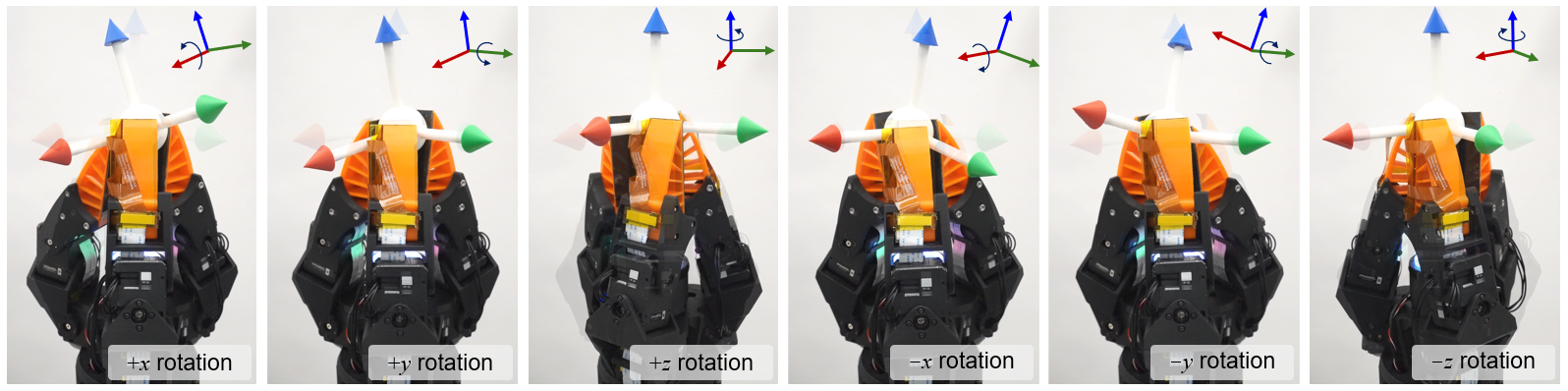
Summary

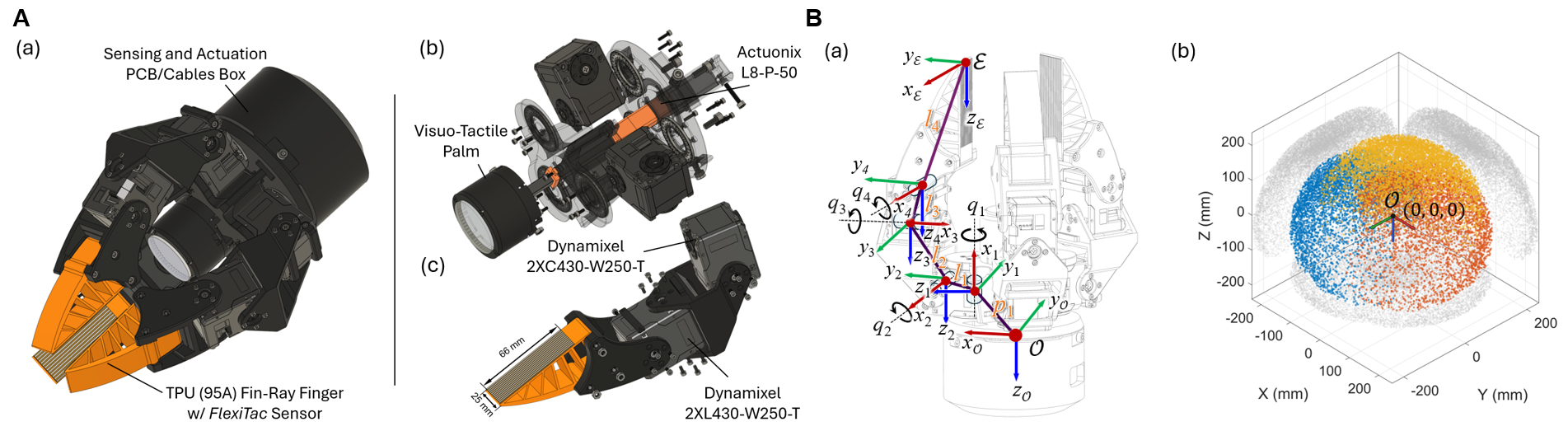
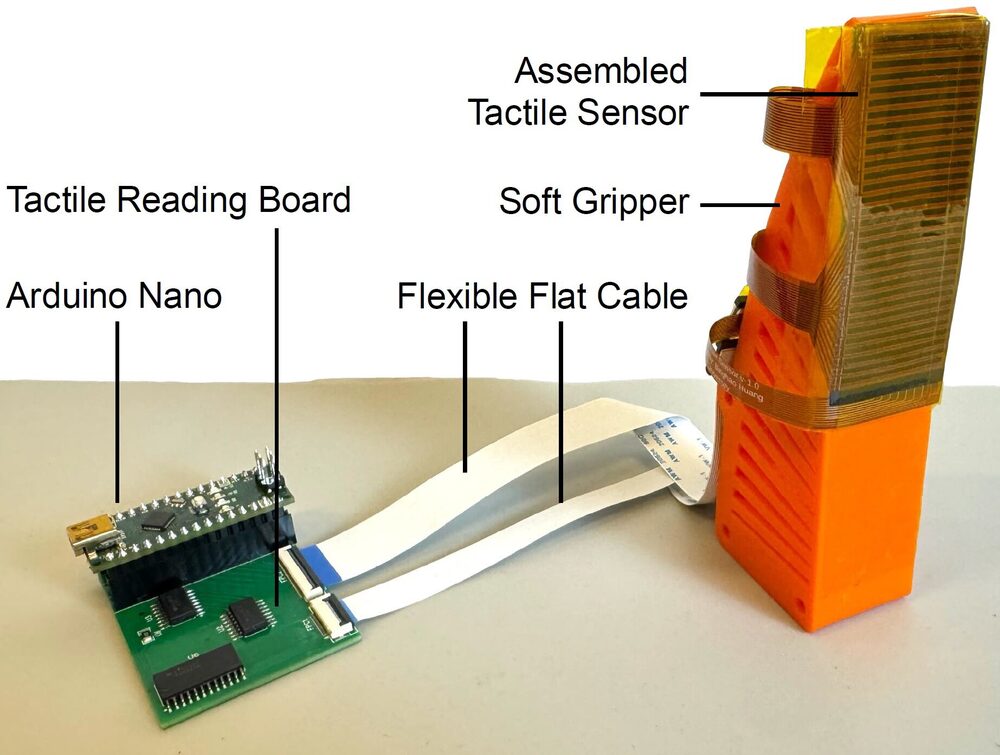
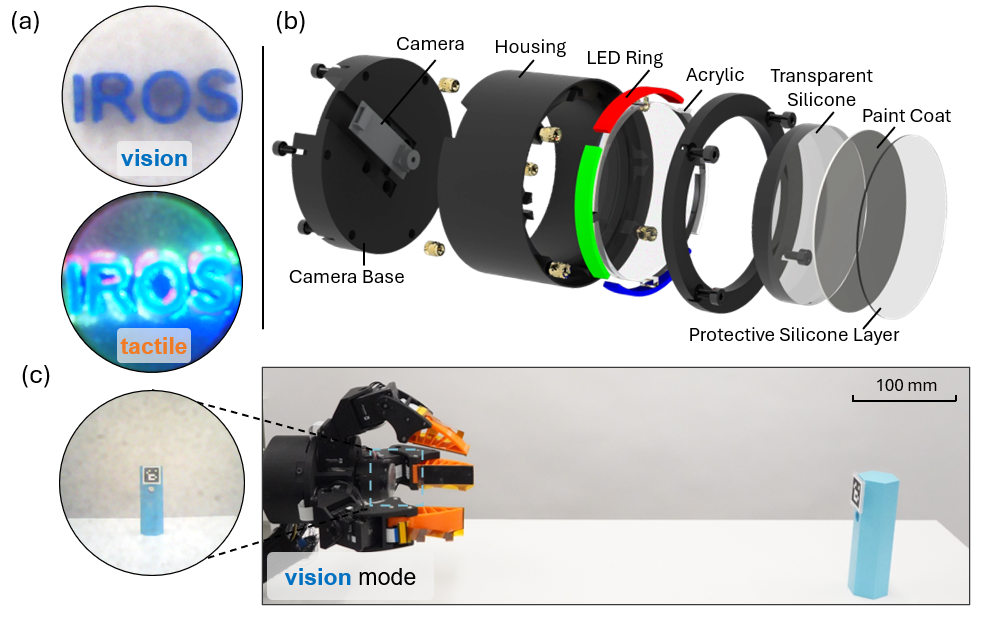
This paper presents a tactile-reactive gripper that integrates a Visuo-Tactile Active Palm (VTAP) and compliant, reconfigurable fingers equipped with tactile array sensors. The design exploits structured finger-palm synergy and multi-modal perception to achieve both robust grasping and fine manipulation. The actuated bi-modal palm seamlessly combines long-range visual localization with contact-rich tactile feedback, substantially extending the system's manipulation capability. To bridge the embodiment gap between human hand motion and the heterogeneous three-finger structure, we further propose a staged, gesture-conditioned retargeting framework for dexterous teleoperation. Extensive experiments validate the system across a range of challenging tasks: reactive grasping of YCB and fragile objects, in-hand syringe reorientation and plunger actuation, singulation of clustered objects down to 3 mm in diameter, and vision-tactile peg-in-hole insertion. Results demonstrate that high manipulation performance can be achieved through coordinated finger-palm interaction and multi-modal sensing, without resorting to high degrees of freedom anthropomorphic designs. The VTAP gripper and its retargeting framework offer a practical reference architecture for dexterous gripper design, manipulation, and contact-rich data collection in support of learning-based approaches.

Design

Mechanical

overview

Sensing

Fingertip tactile sensor
FlexiTac Fingertip Sensing
Visuo-tactile active palm
Visuo-Tactile Active Palm

Retargeting Framework

framework

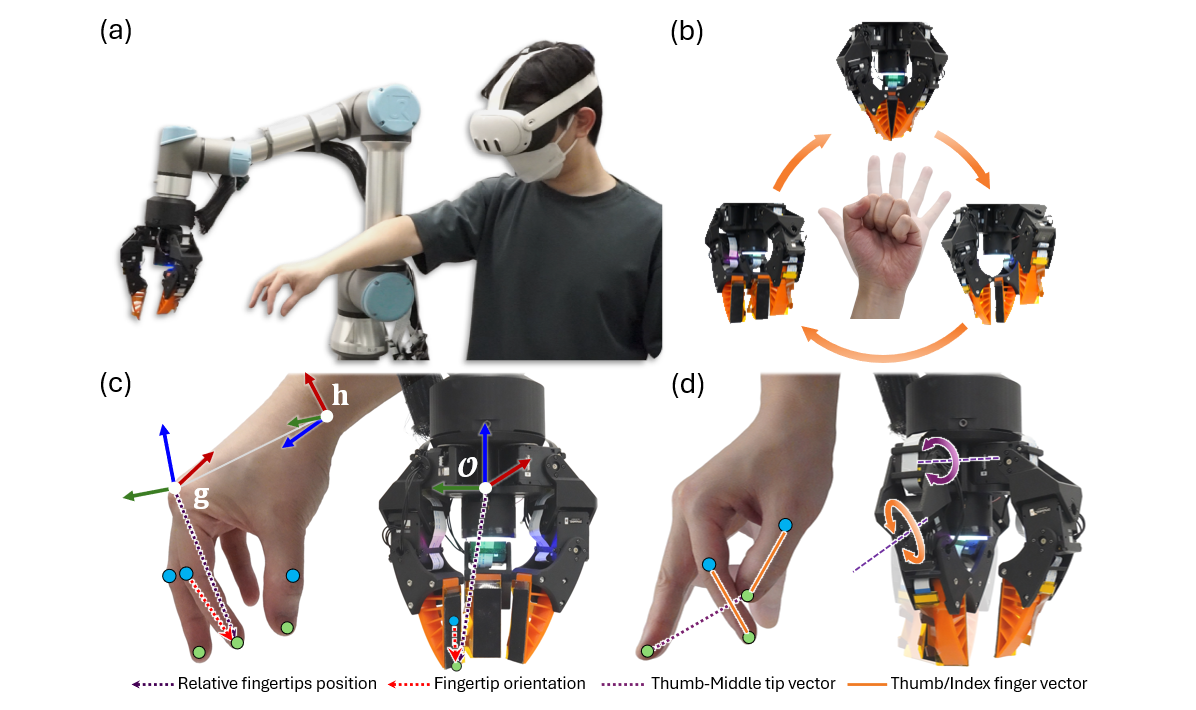
Overview of the proposed retargeting framework for teleoperated dexterous manipulation. (a) Experimental setup. (b) Gesture recognition for selecting grasp primitives of the reconfigurable three-finger gripper (cage, power, and pinch). (c) Key optimization objectives for human-to-gripper retargeting. (d) Mapping of thumb-index rolling motions to the gripper's adduction/abduction DOF for fine in-hand singulation.

Experiments

Tactile-Reactive Grasping

Soccer Ball
Baseball
Rope
Wide Box
Drill
Hammer
Potato Chip
Light bulb
Strawberry

In-Hand Object Reorientation


Singulation


Human Teleoperation
Mung Bean
Gummy Bear
Chocolate Candy
4mm Steel Ball
Swab

Videos of in-hand singulation across five representative objects with varying size, geometry, and stiffness. Each video shows the transition from an initial multi-object grasp with multiple tactile contact patterns, through object removal during in-hand manipulation, to successful isolation of a single object verified by a distinct tactile contact pattern on each fingertip.


Dexterous In-Hand Manipulation


In-hand syringe reorientation and plunger actuation via teleoperation using the proposed gripper. The sequence illustrates pinch-based grasping, in-hand reorientation to align the syringe outlet, and coordinated palm actuation for controlled plunger depression.


Autonomous Peg-in-Hole Insertion


Peg-in-hole insertion enabled by the bi-modal actuated palm. Vision mode is used for initial pose estimation, followed by tactile-based hole localization through edge extraction and circle fitting. Finally, the robotic arm adjusts the end-effector pose based on the estimated hole center and executes peg insertion with a 1 mm tolerance.

Bibtex

@inproceedings{zhou2026vtap,
      title={VTAP Gripper: Synergizing Fingertip Sensing and a Visuo-Tactile Active Palm for Dexterous In-Hand Manipulation},
      author={Yuhao Zhou and Sheeraz Athar and Zhixian Hu and Binghao Huang and Yunzhu Li and Juan Wachs and Yu She},
      booktitle = {2026 IEEE/RSJ International Conference on Intelligent Robots and Systems (IROS)},
      year = {2026}
    }

Acknowledgements

The authors would like to thank Zhonghao Mai for helping with the VR hand-keypoint acquisition module.

This work was supported in part by the National Science Foundation under Award 2423068 and Award 2520136; and in part by the U.S. Department of Agriculture under Award 2023-67021-39072 and Award 2024-67021-42878. Any opinions, findings, and conclusions or recommendations expressed in this material are those of the authors and do not necessarily reflect the views of the funding agencies.